Packaging Choices for Institutional Laundry Detergents: Pails, Drums, Totes, Pods, and Concentrates
Institutional laundry buyers rarely choose detergent packaging on package price alone. The right format affects dosing accuracy, warehouse turns, spill risk, operator training, freight efficiency, and the perceived quality of the chemistry inside.
For manufacturers working with bulk enzymes for detergent manufacturing, packaging decisions also influence formulation architecture. Enzymes need a stable chemical environment, controlled exposure, practical blending pathways, and packaging that protects product performance through distribution and use.
This is not a packaging catalog. It is a buyer-facing review of the tradeoffs that matter when enzyme-enabled laundry detergents move from formulation bench to institutional account.
What institutional buyers are really evaluating
A laundry chemical program is judged in the field, not only in procurement. Packaging must support consistent use by operators under time pressure.
Institutional buyers and distributors usually weigh:
- Dose control: how easily the package supports repeatable dosing into washers or dispensing systems.
- Handling safety: weight, grip, closure integrity, splash exposure, and spill cleanup burden.
- Inventory efficiency: pallet density, rotation speed, partial-container management, and site storage space.
- Compatibility with dispensing equipment: pumps, pickup tubes, dilution systems, and closed-loop connections.
- Total landed cost: freight, damage rate, waste disposal, returns, and labor.
- Product confidence: whether the format reinforces freshness, stability, and professional-use discipline.
The best package is the one that fits the buyer’s operating model while preserving the detergent’s intended wash performance.
Pails: flexible, familiar, but labor-dependent
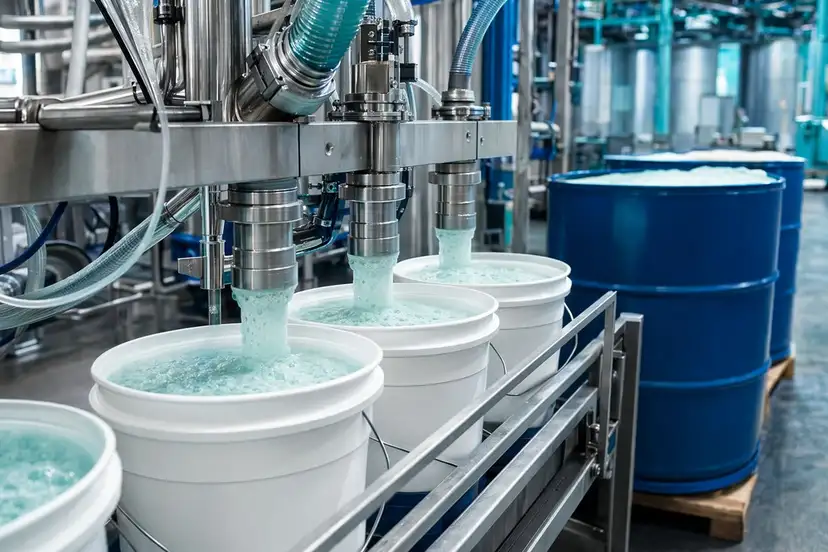
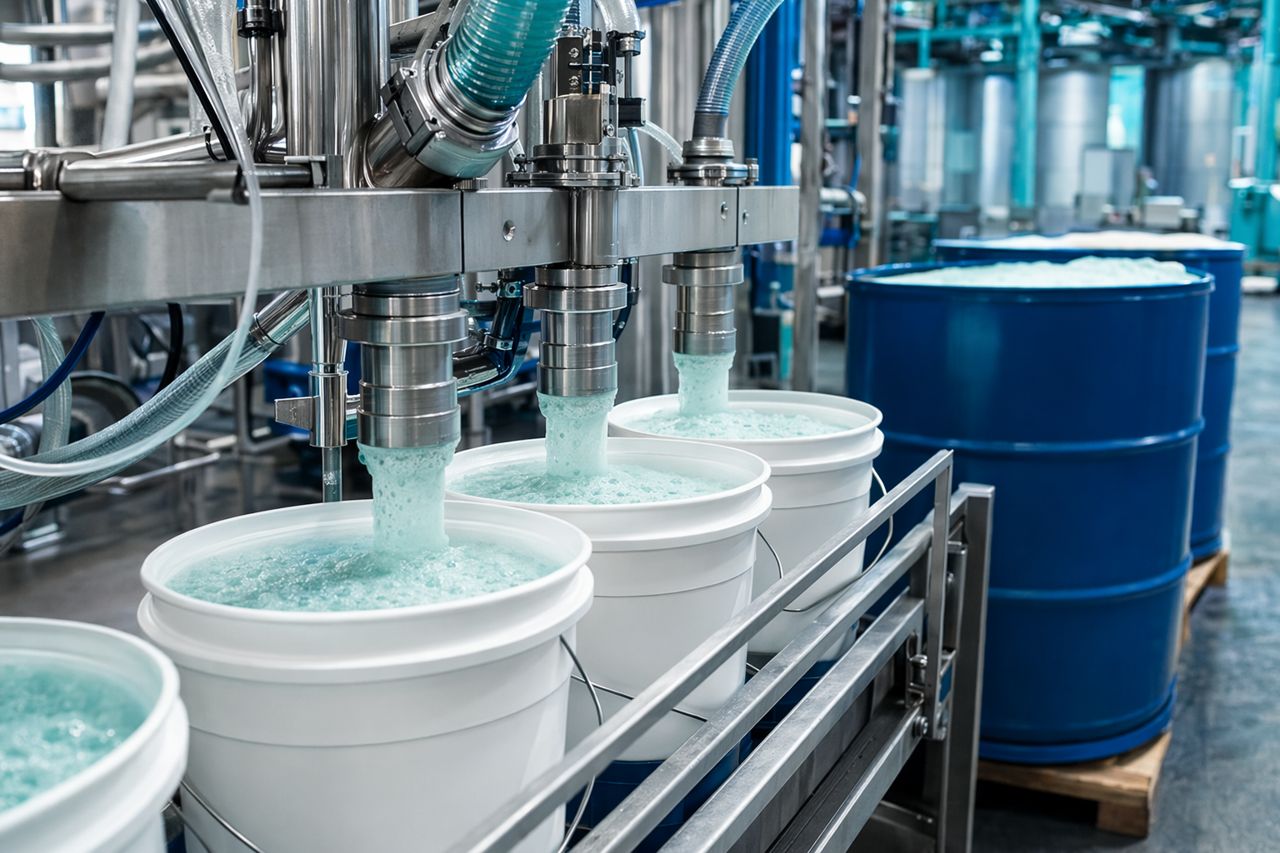
Pails remain common for institutional laundry detergents because they are easy to understand, easy to stock, and practical for smaller routes or multi-product programs.
Where pails work well
- Regional distributors serving mixed account sizes.
- Facilities with limited chemical storage space.
- Powder, liquid, and specialty spot-treatment products.
- Programs where operators manually load or transfer detergent.
Tradeoffs to manage
Pails introduce more touches per volume shipped. That can increase labor, packaging waste, and inconsistent use if operators pour manually. For enzyme-containing liquid detergents, closure integrity and headspace management become important because repeated opening can expose product to moisture, contamination, or temperature swings.
Formulation implications
If a detergent will be sold in pails, formulation teams should validate stability under realistic opening and closing behavior, not only under sealed warehouse conditions. Viscosity, pour behavior, surfactant compatibility, fragrance load, preservatives, builders, and enzyme protection strategy all affect field reliability.
Drums: route-efficient for established institutional volume
Drums suit accounts that consume predictable volumes but do not justify a full tote program. They are also a common bridge format for distributors scaling a successful formula.
Where drums work well
- Medium to large laundry operations.
- Distributor depots consolidating demand across routes.
- Closed or semi-closed dispensing systems.
- Concentrated liquids that benefit from fewer container changes.
Tradeoffs to manage
Drums reduce packaging touchpoints compared with pails, but they require handling equipment, clear labeling, and disciplined connection procedures. If the product is enzyme-enabled, the package should support clean withdrawal and minimize repeated exposure during use.
Formulation implications
For liquid detergents, the drum format can expose weaknesses in physical stability. Phase separation, viscosity drift, sediment, fragrance interaction, and foam behavior during pumping can become more visible at this scale. Foamforge recommends packaging compatibility review before committing a drum format to a national or multi-site program.
Totes: strong economics for high-throughput laundries
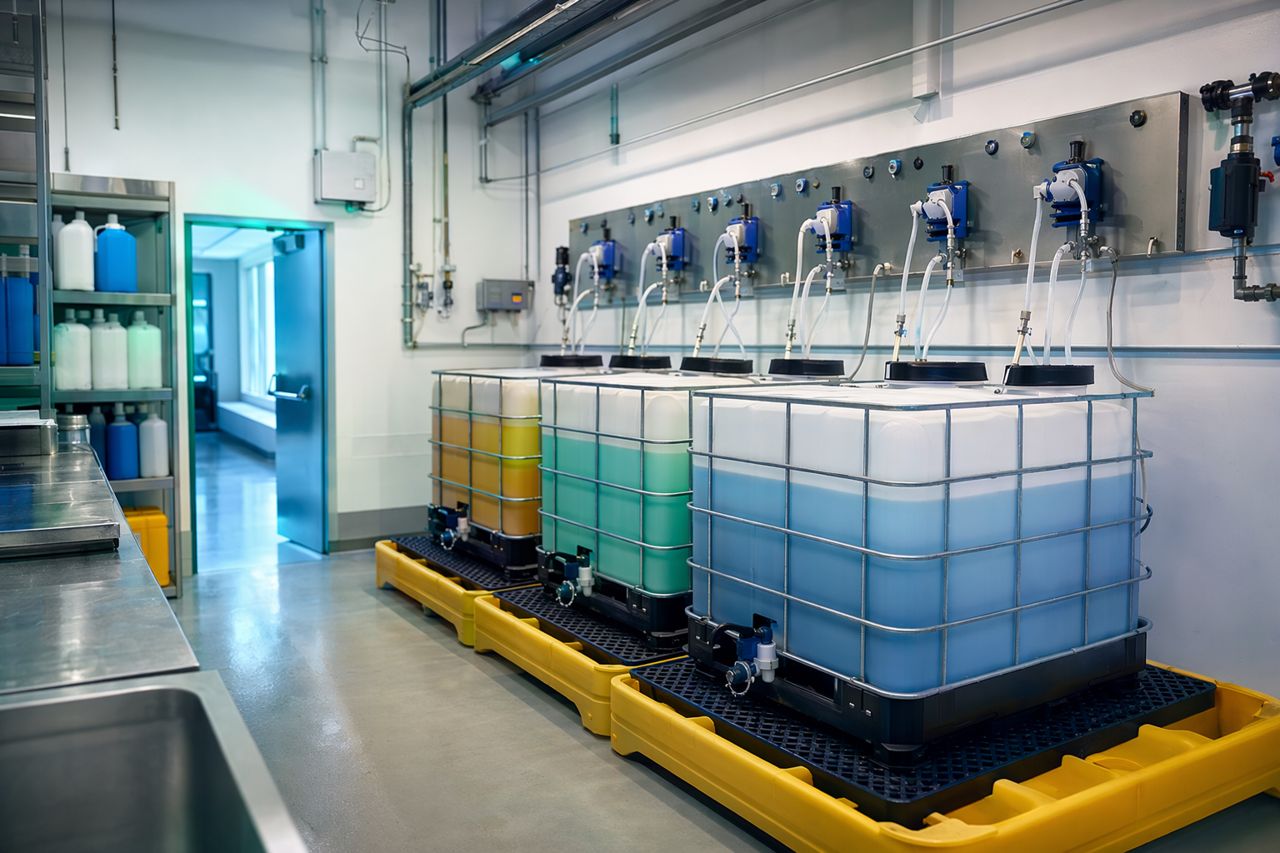
Totes can reduce freight and handling cost per delivered volume, especially for high-throughput institutional laundries with automated dispensing.
Where totes work well
- Large hospitality, healthcare, correctional, and linen processing facilities.
- Central laundries with controlled chemical rooms.
- Programs using fixed dispensing hardware.
- Buyers prioritizing fewer deliveries and lower container turnover.
Tradeoffs to manage
Totes demand space, equipment access, and operator discipline. Returns, cleaning, contamination control, and deposit management can influence commercial acceptance. If the product is a concentrate, an error in connection or dilution can affect a large number of wash loads quickly.
Formulation implications
Tote packaging places more pressure on long-duration stability and pumpability. Enzyme-compatible formulation design should account for surfactant system, solvent package, water quality tolerance, chelation, alkalinity, and preservative strategy. The package is not a substitute for formulation stability; it is part of the stability system.
Pods and unit-dose formats: compliance benefits, different manufacturing burden
Pods and soluble unit-dose formats can improve compliance because the dose is pre-measured. They are attractive where operator training is limited or where chemical access needs tighter control.
Where unit dose works well
- Smaller institutional accounts.
- Managed laundry programs requiring simple operator instructions.
- Environments where spills and over-pouring are persistent issues.
- Premium or specialty wash products.
Tradeoffs to manage
Unit-dose packaging can raise manufacturing complexity, packaging cost, film compatibility requirements, and sensitivity to storage conditions. It also limits dosing flexibility for variable soil loads, machine sizes, and water conditions.
Formulation implications
Enzyme-containing unit-dose products require careful compatibility review across film, moisture profile, builders, surfactants, alkalinity, and fragrance. The product must remain manufacturable, stable in storage, and reliable during wash release. A strong unit-dose concept can fail commercially if it is too sensitive for real institutional storage rooms.
Concentrates: powerful economics when dilution is controlled
Concentrates are often the most commercially attractive format for detergent manufacturers and distributors because they reduce shipped water, improve pallet efficiency, and create space for value-added performance chemistry.
Where concentrates work well
- Distributor dilution programs.
- On-site dispensing systems with calibrated dilution.
- Private-label programs needing freight efficiency.
- Facilities with trained staff and clear operating procedures.
Tradeoffs to manage
Concentrates transfer more responsibility to dilution control. If the dilution step is inconsistent, the buyer may blame the chemistry rather than the process. Clear instructions, compatible dispensing hardware, and stable concentrates are essential.
Formulation implications
Enzymes can help concentrates deliver stronger cleaning at lower applied detergent levels, but the formulation must protect enzyme performance in the concentrate matrix. High surfactant levels, solvents, builders, oxidants, pH, preservatives, and fragrance can all interact. The correct enzyme system should be selected for the real formulation, not added after the detergent architecture is already locked.
Packaging choice affects enzyme sourcing decisions
When detergent manufacturers evaluate bulk enzyme supply, packaging strategy should be discussed early. A formula designed for sealed drums may not behave the same way in repeatedly opened pails, unit-dose film, or a high-strength concentrate.
Foamforge supports formulation leaders with practical guidance across:
- Enzyme selection for laundry detergent positioning.
- Compatibility review with surfactants, builders, chelants, solvents, preservatives, and fragrance systems.
- Stability planning for intended packaging and distribution conditions.
- Scale-up support from lab blend to plant batch.
- Supply planning for recurring production schedules.
The goal is not to overcomplicate the detergent. The goal is to prevent packaging, formulation, and supply decisions from working against each other.
Distributor perspective: the format must sell operationally
A distributor may like a detergent’s cleaning story, but the package must also fit route economics.
Strong distributor-fit packaging usually has:
- Clear front-panel product differentiation.
- Robust secondary packaging for pallet movement.
- Closure systems that reduce leaks and returns.
- Labeling that supports fast warehouse identification.
- Pack sizes aligned with account type and delivery rhythm.
- Enough stability margin for seasonal temperature variation.
For enzyme-enabled detergents, distributors also need confidence that the product will remain consistent through normal storage and delivery patterns. Technical support should be available before field complaints become commercial risk.
Buyer questions before locking a package format
Before selecting pails, drums, totes, pods, or concentrates, formulation and commercial teams should align on these questions:
- Who physically handles the detergent at the account?
- Is dosing manual, semi-automatic, or fully dispensed?
- How often will containers be opened, moved, or connected?
- What storage temperatures are realistic, not idealized?
- Does the package encourage correct use or invite improvisation?
- Can the formula remain physically and functionally stable in this format?
- Does the format support distributor margin after freight, returns, and handling?
- Is enzyme compatibility validated against the actual detergent matrix?
If these answers are unclear, delay the packaging decision until the formula, buyer segment, and route-to-market are better defined.
Practical recommendation
For most institutional laundry detergent manufacturers, the right path is not one universal pack. It is a staged packaging strategy:
- Pails for access, trials, smaller accounts, and route flexibility.
- Drums for established volume and dispensing compatibility.
- Totes for high-throughput sites with disciplined chemical management.
- Pods where compliance and simplicity outweigh flexibility.
- Concentrates where dilution control and freight efficiency are commercially important.
Packaging should be selected alongside the detergent’s enzyme system, not after it. That is where performance, stability, and commercial execution meet.
Request formulation and supply guidance
If you are developing or scaling an institutional laundry detergent and need bulk enzyme supply aligned with your packaging plan, Foamforge can help review compatibility, stability expectations, and production readiness.
Request a quote through the on-site contact form and include your detergent type, target package format, production scale, and key formulation constraints. We will respond with practical next steps for enzyme selection and supply planning.