Distributor Training for Enzyme Laundry Detergents: What Sales Teams Need to Explain
For industrial cleaning product manufacturers, distributor education can decide whether an enzyme laundry detergent is sold as a value product or treated as another commodity drum on the shelf. The chemistry may be sound, the formulation may be stable, and the label may be compliant, but if the distributor cannot explain where enzymes work, where they do not, and how accounts should use the product, the customer experience becomes inconsistent.
Training is especially important when positioning bulk enzymes for detergent manufacturing inside commercial laundry, hospitality, healthcare, foodservice, workwear, and institutional cleaning channels. Enzyme detergents are not difficult to sell, but they require a clearer conversation than standard alkaline builders and surfactant systems.
This guide outlines what manufacturer-led distributor training should cover so sales teams can explain enzyme value without overclaiming.
Why distributor training matters for enzyme laundry products
Distributor representatives are often the first technical voice the end user hears. They influence:
- Which accounts are targeted for an enzyme detergent
- Whether the product is presented as a premium performance tool or a general-purpose wash chemical
- How dosing, temperature, and cycle design are explained
- Whether customer complaints are solved correctly or misdiagnosed
- How claims are repeated in sales decks, emails, and product demonstrations
When training is vague, distributors may oversell enzymes as universal stain removers or undersell them as minor additives. Both outcomes reduce commercial confidence.
A better training program gives sales teams controlled, formulation-led language: what enzymes do, which soils they target, what conditions support performance, and how to recognize the right customer fit.
The first concept: enzymes are targeted soil tools
Distributors do not need to become biochemists. They do need a practical model they can repeat to customers:
Enzymes help break specific soil structures into smaller, more removable fragments during the wash process.
That sentence is more useful than describing enzymes as “power boosters.” It frames the ingredient as targeted, process-dependent, and compatible with a complete detergent system.
Key enzyme functions to explain
| Enzyme class |
Practical soil conversation |
Common account relevance |
| Protease |
Helps address protein-rich soils such as food residues, sweat, blood, dairy, and body soils |
Hospitality, healthcare, foodservice, care facilities, workwear |
| Amylase |
Helps release starch-based soils from sauces, gravies, cereal residues, and processed foods |
Restaurants, catering, kitchens, food production uniforms |
| Lipase |
Supports removal of fats, oils, greases, and lipid soils when the wash system is designed for it |
Foodservice, spa linens, workwear, kitchens |
| Cellulase |
Helps manage cotton surface fuzzing and can support fabric appearance in selected formulations |
Hospitality linens, apparel care, premium laundry programs |
| Mannanase |
Helps target guar and mannan-based thickeners used in processed foods and personal care products |
Hospitality, foodservice, institutional laundry |
The distributor message should be simple: different soils respond to different enzyme functions, and the best detergent design depends on the customer’s soil profile.
Teach soil diagnosis before product pitching
Many sales teams start with product features. Better training starts with the customer’s laundry reality.
Questions distributors should ask
- What are the dominant stains or soils: food, protein, oil, cosmetic, starch, body soil, outdoor soil, or mixed soil?
- Are rewash piles driven by stains, odor, dinginess, fabric damage, or poor cycle control?
- What textile types are most common?
- Is the account washing at lower temperatures for energy management?
- Are bleach, high alkalinity, disinfecting steps, or oxidizing chemicals used in the same process?
- Is the current complaint visual stain removal, odor, whiteness, softness, or cost per processed load?
- Does the account have consistent dosing equipment and water quality control?
These questions help distributors avoid selling an enzyme detergent into the wrong problem. For example, an enzyme system may help with food and body soils, but it will not correct poor mechanical action, overloaded washers, unmanaged water hardness, or incompatible chemical sequencing.
Correct use: what distributor teams must explain
Enzyme detergents perform best when the full wash environment supports them. Distributor training should include practical use conditions without overwhelming the sales team.
1. Temperature window
Enzymes are sensitive to temperature extremes. A trained distributor should explain that enzyme laundry detergents are commonly positioned where controlled-temperature washing is part of the value proposition. If the cycle is too cold, soil release may slow. If conditions are too harsh, enzyme contribution can be reduced.
The correct message is not “enzymes work in every wash.” The correct message is: enzymes support soil removal when the wash process is designed around compatible conditions.
2. pH and alkalinity
Laundry detergents often use alkalinity to help remove soils. Enzyme stability and performance depend on formulation balance. Distributor teams should understand that enzyme-containing products are engineered to work within defined formulation and wash conditions, not randomly mixed into any high-alkaline process.
3. Bleach and oxidizers
Oxidizing chemistries can reduce enzyme contribution if they are not sequenced correctly. Distributors should be trained to avoid telling accounts to mix enzyme detergent directly with bleach concentrates or incompatible chemicals.
A practical line for sales teams:
Use the product according to the manufacturer’s wash program. Do not combine enzyme detergents with incompatible oxidizing concentrates unless the program has been validated.
4. Contact time
Enzymes need time in solution to act on target soils. If cycles are shortened aggressively, performance may not match expectations. Distributor training should connect enzyme value to the total wash process: dosing, dilution, temperature, time, mechanical action, and rinse quality.
5. Storage and handling
Distributors should know how to protect inventory and customer confidence:
- Store sealed containers in controlled conditions
- Avoid prolonged exposure to heat
- Rotate stock by receipt date
- Prevent contamination from other chemical products
- Keep technical documents current and accessible
These are basic supply-chain habits, but they matter when selling higher-value formulated systems.
Account segmentation: where enzyme detergents are easiest to defend
Not every account needs the same enzyme story. Distributor training should map enzyme products to customer segments with clear commercial logic.
Hospitality laundries
Primary soils include body oils, food residues, cosmetic residues, and mixed linen soils. The sales message should focus on consistent stain support, fabric-care positioning, and reducing avoidable rewash when wash conditions are controlled.
Foodservice and restaurant accounts
These accounts often deal with starches, sauces, oils, proteins, and persistent odor. Distributor teams should emphasize enzyme targeting by soil type and the importance of compatible detergent selection for kitchen textiles, aprons, towels, and uniforms.
Healthcare and care facilities
Training must be careful and compliant. Enzyme detergents can support removal of organic soils before downstream hygiene steps, but they should not be presented as disinfectants unless the finished product is properly registered and labeled for that claim. Sales language should separate cleaning performance from antimicrobial claims.
Workwear and industrial uniforms
Oils, greases, protein soils, sweat, and particulate soils may be present together. Distributors should qualify the soil load and wash process before proposing an enzyme detergent. Heavy petroleum or mineral soils may require additional surfactant, solvent, or builder strategy.
On-premise laundries with energy goals
Where accounts are trying to manage wash temperature and utility cost, enzyme detergents can be part of the conversation. The claim should be framed around process design and validated customer trials, not a blanket guarantee.
Claims distributors can make — and claims they should avoid
Enzyme laundry products sell best when claims are specific, responsible, and repeatable.
Strong, practical claims
- Helps target protein, starch, fat, or specific food-derived soils depending on enzyme selection
- Supports stain removal within a properly designed wash process
- Can help reduce avoidable rewash when soil type and wash conditions are aligned
- Enables differentiated detergent positioning for commercial laundry accounts
- Supports lower-temperature laundry programs when validated in the finished formulation and customer process
- Provides a technical story distributors can use beyond price comparison
Claims to avoid
- “Removes every stain”
- “Works under all wash conditions”
- “Replaces bleach”
- “Disinfects” unless the finished product is registered and labeled for that use
- “Eliminates rewash”
- “Safe to mix with any laundry chemical”
- “Guaranteed energy reduction” without validated account data
Distributor teams should leave training with approved sales language, not improvisation.
Build the training around evidence, not hype
For manufacturers, the most effective distributor programs include a practical evidence pack. This does not need to be academically complex. It should help the distributor defend the product in front of a laundry manager, purchasing lead, or facilities director.
Useful materials include:
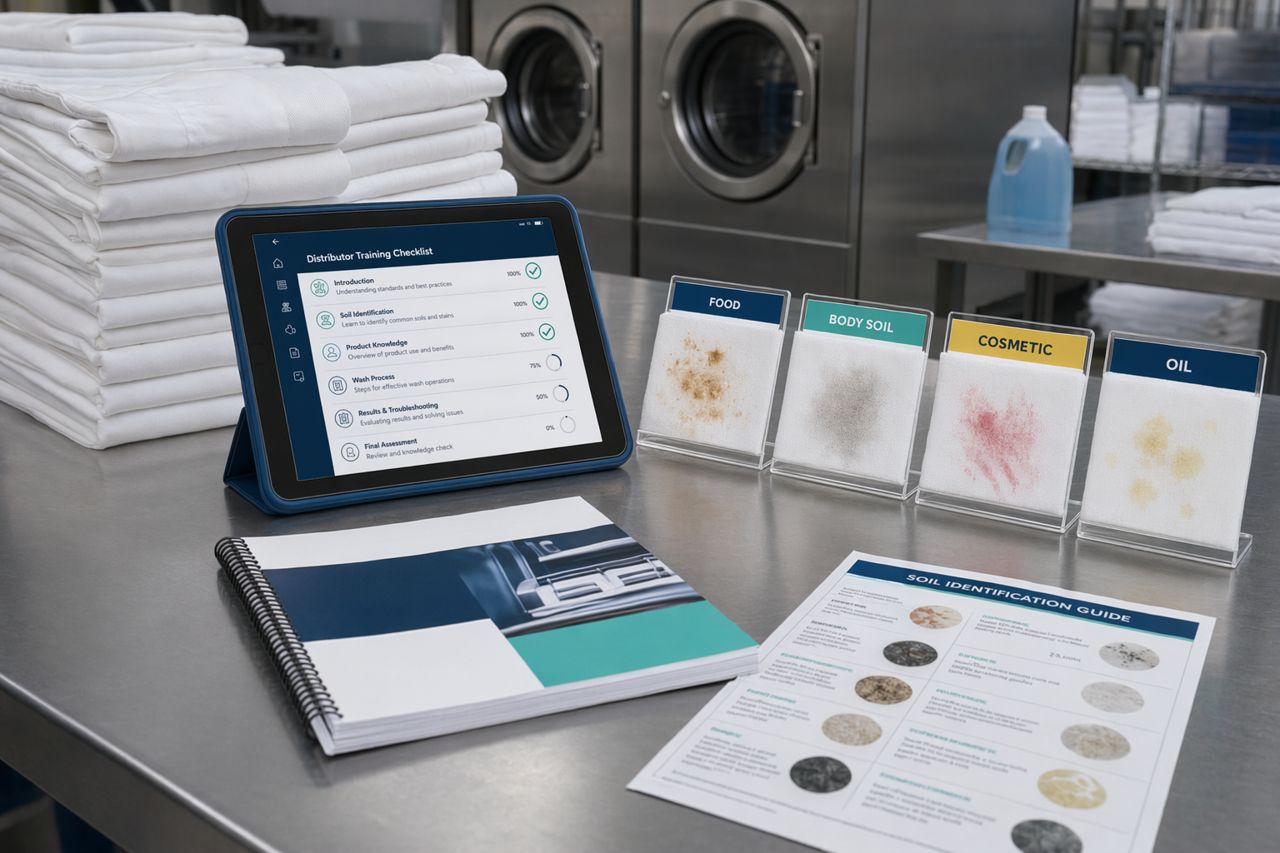
- Soil-type explanation sheets
- Before-and-after stain panel photography from controlled comparative washes
- Segment-specific sales talk tracks
- Compatibility notes for common laundry chemistries
- Storage and handling guidance
- Trial setup templates for customer demonstrations
- Objection-handling scripts
- Claim boundaries approved by technical and regulatory teams
The goal is to create a repeatable commercial system: distributors know who to target, how to explain performance, and when to escalate technical questions back to the manufacturer.
Objection handling for distributor sales teams
“Why should the customer pay more?”
Because the product is not only a detergent base. It is a targeted soil-management system. The correct value conversation includes rewash, linen appearance, customer satisfaction, wash program design, and differentiation from commodity products.
“Can we sell it to every laundry account?”
No. Train distributors to qualify accounts first. Enzyme detergents are strongest where target soils are present and the wash process supports enzyme contribution.
“Will it work in cold water?”
The trained answer should be conditional: enzyme systems may support performance at reduced temperatures when the formulation and wash cycle are designed for that use. Customer trials should confirm the result.
“Can it replace our current bleach step?”
Usually that is the wrong framing. Enzymes clean by targeting soil structures. Bleach is used for whitening, stain oxidation, or hygiene programs depending on the system. Distributor language should keep those functions separate.
“What if the customer sees inconsistent results?”
Check dosing, water temperature, cycle time, soil classification, machine loading, water quality, chemical sequencing, and storage conditions before blaming the product. Inconsistent laundry outcomes are often process-related.
A practical distributor training structure
A manufacturer-led program can be delivered in one technical-commercial session with follow-up materials.
Module 1: Enzyme basics for sales teams
Explain enzyme function by soil type. Avoid deep assay language. Focus on what the rep needs to explain confidently.
Module 2: Product positioning
Define which product fits which account segment. Provide approved messaging for hospitality, foodservice, healthcare, workwear, and institutional laundry.
Module 3: Correct use and compatibility
Cover temperature, pH, oxidizers, cycle design, dosing discipline, storage, and handling.
Module 4: Trial execution
Show distributors how to set up a credible customer trial: identify target stains, document baseline performance, control wash variables, compare results, and review rewash outcomes.
Module 5: Claims and compliance
Train sales teams on what they can say, what they should not say, and when to ask for manufacturer support.
Module 6: Quote and scale-up pathway
If the distributor is feeding demand back to the manufacturer, define how inquiries move from sample evaluation to formulation confirmation, packaging format, batch planning, and recurring supply.
Manufacturer checklist for distributor-ready enzyme detergent launches
Before asking distributors to sell the product, confirm that your internal team has prepared:
- Finished formulation positioning by soil type
- Compatibility guidance for common laundry programs
- Validated label and sales claims
- Storage and transport recommendations
- Product comparison language against non-enzyme detergents
- Trial protocol for target accounts
- Training deck and quick-reference sheet
- Technical escalation contact
- Forecasting assumptions for distributor uptake
- Bulk enzyme supply plan for ongoing production
The commercial risk is not that distributors ask too many questions. The risk is that they are forced to answer without the right framework.
Where Foamforge supports manufacturers
Foamforge works with industrial cleaning product manufacturers developing enzyme-enabled detergent systems for laundry and broader cleaning applications. Our focus is formulation fit, compatibility guidance, supply reliability, and scale-up confidence for manufacturers buying enzyme concentrates and integrating them into finished products.
If you are building a distributor program around enzyme laundry detergents, we can help align enzyme selection, application positioning, and commercial documentation before the product reaches the sales channel.
Planning a new enzyme laundry detergent or reformulating an existing line? Request a quote through our on-site contact form and share your target soil profile, product format, and production requirements.