Private-Label Institutional Laundry Detergent: Opportunities for Regional Chemical Brands
Regional chemical brands are well positioned to win institutional laundry accounts when they combine local service, dependable fill capacity, and formulation credibility. The opportunity is not simply to copy a national detergent. It is to build a private-label line that fits distributor expectations, laundry workflows, packaging economics, and the soil profile of the local market.
For formulation leaders, enzyme selection can be one of the clearest ways to move a private-label institutional detergent away from commodity positioning. The right enzyme system can support stain removal, brightness maintenance, odor control, and lower-temperature wash performance while preserving the manufacturing practicality required for repeat commercial batches.
Foamforge supplies and supports bulk enzymes for detergent manufacturing for B2B cleaning product manufacturers that need technical confidence before scale-up.
Why regional private-label laundry is gaining traction
Institutional buyers are under pressure to control cleaning cost without risking visible performance failures. Hotels, food-service laundries, healthcare-adjacent facilities, gyms, uniforms, and contract cleaners all need reliable detergent performance across mixed soils and inconsistent wash conditions.
Regional brands can compete by offering:
- Shorter lead times and responsive service compared with distant national suppliers
- Packaging formats matched to local distributor routes and laundry dosing systems
- Faster formulation adjustments for regional water hardness, soil types, and machine habits
- Private-label branding that helps distributors protect margin
- Commercial supply relationships that feel accountable, not anonymous
The strongest private-label programs are built as product platforms, not one-off blends.
What institutional laundry buyers expect
A private-label detergent may be sold under a distributor name, but the buyer still judges it like a professional product. Performance complaints move quickly when linens retain grease, towels dull, or uniforms carry residual odor.
Formulators should design around five buyer expectations:
1. Consistent cleaning across variable loads
Institutional laundry is rarely controlled like a laboratory trial. Loads vary by fabric, soil level, wash program, dosing behavior, and water quality. Enzymes help target common soil classes that general surfactant systems may not fully remove on their own.
2. Compatibility with existing wash chemistry
Institutional programs often use detergent alongside alkali builders, oxygen bleach, souring agents, softeners, and spot treatments. Enzyme concentrates must be selected and incorporated with the wider formulation and use environment in mind.
3. Practical manufacturing behavior
A high-performing formula is not commercially useful if it creates avoidable problems in the plant. Foam control, mixing order, viscosity movement, preservative compatibility, and storage stability all matter when the product moves from pilot to production.
4. Clear claims without overreach
Private-label products need credible language for labels, distributor sell sheets, and tenders. Buyers respond to claims that are specific, defensible, and tied to application value, such as protein stain removal support, starch soil breakdown, body oil removal support, and fabric appearance maintenance.
5. Reliable supply and quote discipline
Regional brands cannot build channel trust if inputs create lead-time surprises. Bulk enzyme sourcing should be planned around production cadence, packaging format, and forecast confidence.
Ingredient differentiation: where enzymes create value
Enzymes are not a decoration on the ingredient list. In institutional laundry, they can help the detergent address soil categories that define whether a wash result looks professional.
Protease for protein-heavy soils
Protease is commonly used to support removal of protein-based soils such as food residues, perspiration-related deposits, and biological stains. For institutional programs, protease can help improve first-pass cleaning when operators cannot rely on long, aggressive wash cycles.
Amylase for starch and food soils
Food-service linen, kitchen towels, and uniforms can carry starch-based residues from sauces, thickeners, and processed foods. Amylase selection can help reduce the persistence of these soils and support cleaner textile appearance.
Lipase for fatty and oily soils
Body oils, kitchen grease, lotions, and certain industrial residues can challenge standard detergent systems. Lipase can support the breakdown of lipid soils when matched to the detergent architecture and target wash conditions.
Cellulase for fabric appearance support
Cellulase can support fabric surface maintenance by helping reduce microfibril-related dullness on cotton-rich textiles. Used appropriately, it can help private-label products communicate value beyond basic soil removal.
Multi-enzyme blends for broad institutional coverage
Many private-label programs need broad performance rather than a single narrow claim. A blend approach can support a wider soil profile, but it must be balanced against formulation stability, cost-in-use targets, and manufacturing constraints.
Packaging and channel strategy
Private-label success depends on more than the formulation. The package must fit the buying channel and the physical reality of dispensing.
Common institutional formats include:
- Concentrated liquid detergents for dispenser-fed laundry rooms
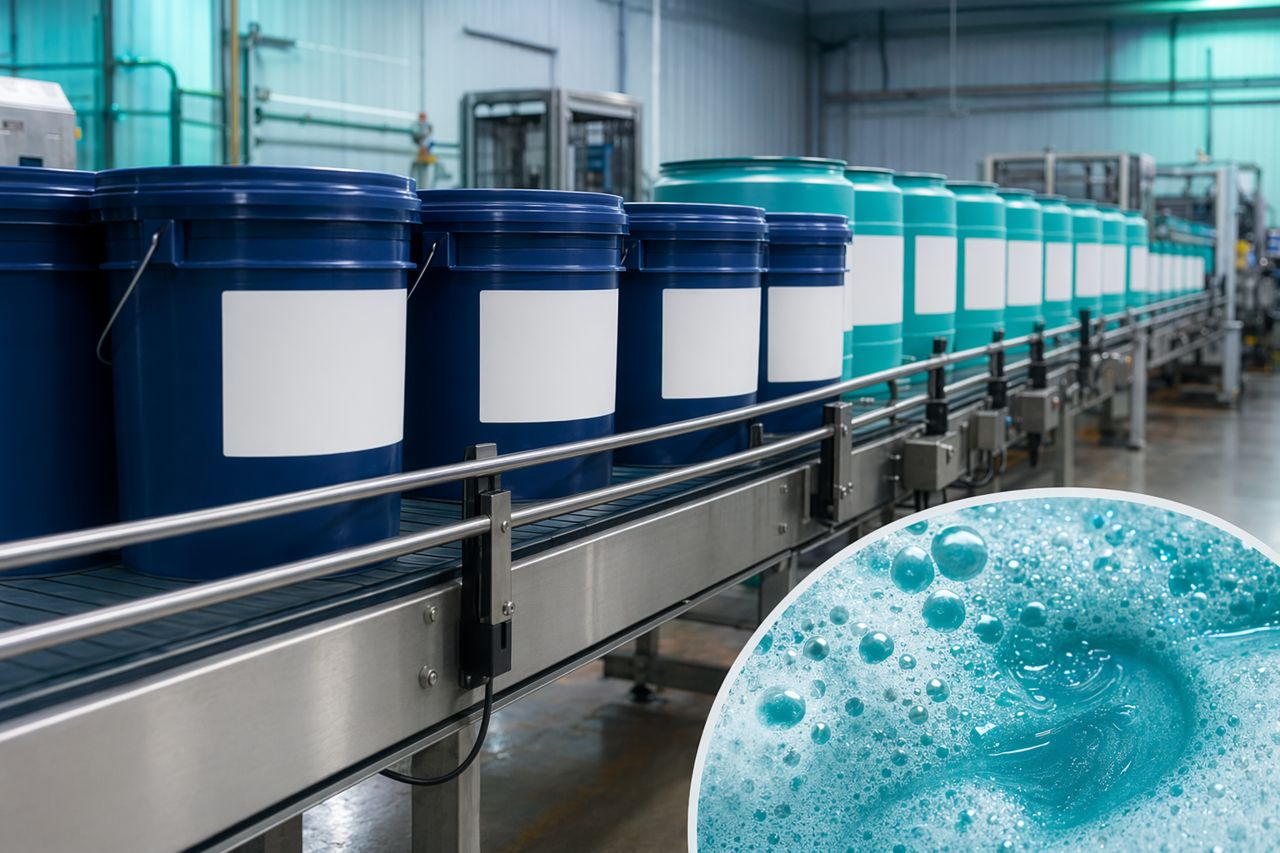
- Pails and drums for distributor-managed accounts
- Smaller commercial packs for janitorial and facility supply channels
- High-solids or concentrated formats where freight and storage efficiency are priorities
- Companion products positioned as a complete laundry program
For regional brands, packaging can become a competitive advantage. A distributor may choose a private-label line because the case count, closure, label panel, pallet configuration, and reorder rhythm work better for its customers.
Positioning private-label detergent without racing to the bottom
A private-label institutional laundry detergent should not be positioned only as cheaper. Regional chemical brands can create stronger margin by anchoring the product around operational value.
Useful positioning angles include:
- Enzyme-supported stain performance for mixed institutional soils
- Lower-temperature wash support where energy reduction is a buyer priority
- Formulation guidance for regional water conditions
- Distributor-exclusive branding with dependable replenishment
- A complete laundry program rather than a single detergent SKU
- Technical support for launch, troubleshooting, and account conversion
The goal is to make the distributor feel it is gaining a controllable product line, not simply substituting one commodity for another.
Formulation risks to manage before scale-up
Enzyme-enabled detergents require disciplined development. The most common risks are manageable when addressed early.
Surfactant and builder compatibility
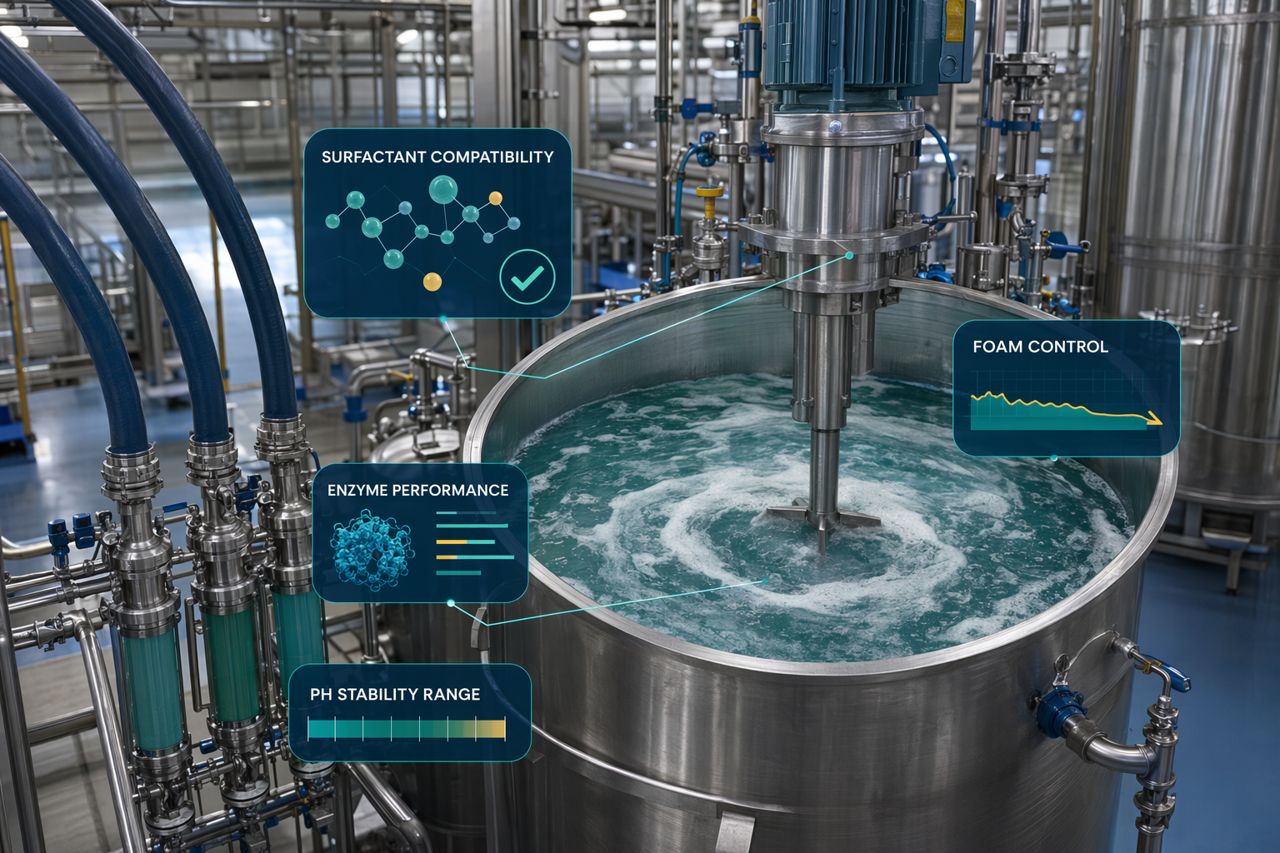
An enzyme concentrate must be reviewed against the anionic, nonionic, amphoteric, builder, and alkalinity profile of the detergent. Compatibility decisions affect stability, performance retention, and mixing behavior.
Preservatives, dyes, and fragrance systems
Institutional products still need acceptable appearance and odor. Preservatives, dyes, and fragrance components should be screened for compatibility with the enzyme package and the finished detergent profile.
Foam behavior
Laundry detergents must clean effectively without creating uncontrolled foam in equipment. Enzyme addition does not replace foam design. It should be integrated with the surfactant and defoaming strategy.
Manufacturing sequence
Order of addition can influence dispersion, viscosity, heat exposure, and finished product uniformity. Foamforge supports practical dosing and incorporation guidance for production teams working with bulk enzyme concentrates.
Storage and logistics
Private-label brands need commercial shelf confidence. Bulk enzyme selection should consider warehouse conditions, packaging choice, turnover rate, and distribution routes.
How Foamforge supports private-label detergent manufacturers
Foamforge works with industrial cleaning product manufacturers that need enzyme inputs and formulation guidance aligned with commercial production. Our role is to help your team move from opportunity to manufacturable detergent line with fewer unknowns.
We support:
- Enzyme selection for target laundry soil profiles
- Compatibility guidance for detergent systems
- Bulk concentrate sourcing for planned production volumes
- Scale-up considerations for mixing, handling, and packaging
- Private-label claim direction grounded in application value
- Quote planning based on format, volume, and supply cadence
We do not position enzyme chemistry as a magic fix. We help formulation leaders make controlled, commercially useful decisions.
Launch checklist for a regional private-label laundry line
Before committing to a launch, align the commercial and technical plan:
- Define the primary channel: distributor, laundry operator, facility supply, hospitality, food service, or mixed commercial accounts.
- Identify the soil profile the product must handle.
- Choose the detergent format and package before finalizing cost targets.
- Set realistic performance claims for labels and sell sheets.
- Review enzyme compatibility against surfactants, builders, alkalinity, preservatives, dyes, and fragrance.
- Confirm manufacturing sequence and handling requirements.
- Build a replenishment forecast that supports supply reliability.
- Prepare distributor-facing technical language that sales teams can use confidently.
Request a quote for bulk enzyme supply
If you are developing a private-label institutional laundry detergent, Foamforge can help specify the right enzyme concentrate for your formulation, packaging format, and production plan.
Request a quote using the on-site form and include your detergent format, target soil profile, approximate production volume, and any known compatibility constraints.