Textile Life Extension in Commercial Laundry Chemistry
How industrial cleaning product manufacturers can position textile care, lint control, and repeat-wash appearance with responsible enzyme-based formulation strategies.
Request pricing How industrial cleaning product manufacturers can position textile care, lint control, and repeat-wash appearance with responsible enzyme-based formulation strategies.
Request pricingFor commercial laundry detergent brands, cleaning performance is only part of the value equation. Hotels, healthcare laundries, food service operators, uniform rental programs, and industrial laundries also watch textile replacement cost, garment appearance, lint load, and repeat-wash damage.
That creates a formulation opportunity: detergent systems that clean effectively while helping fabrics retain a more acceptable visual and tactile condition over many cycles. For manufacturers sourcing bulk enzymes for detergent manufacturing, textile life extension is not a single-ingredient promise. It is a system-level positioning strategy involving enzyme selection, alkalinity, surfactant balance, builder load, wash temperature, mechanical action, and claim discipline.
Foamforge supports industrial cleaning product manufacturers with enzyme ingredient guidance for scalable detergent platforms where fabric care, soil removal, and production reliability need to work together.
Commercial laundry buyers do not always describe the problem as fiber damage. They usually describe operational symptoms:
A detergent brand that can speak responsibly to these pain points gains a stronger commercial story than stain removal alone. The buyer value is practical: better perceived textile quality, fewer visible defects, and detergent chemistry that supports repeat-use economics.
Textile appearance changes through multiple overlapping mechanisms. Detergent formulation can reduce some contributors, but it cannot override poor fabric construction, excessive wash aggression, or uncontrolled laundering conditions.
Key contributors include:
High load friction, aggressive extraction, and repeated tumble action can raise fiber ends on cotton and cotton-rich fabrics. This creates fuzz, pilling, dullness, and lint release.
Strong alkaline systems and oxidizing components can be necessary in heavy-duty laundering, especially for hygiene-focused programs. However, excessive exposure can affect dyes, elastic components, finishes, and fiber feel. Formulation leaders must balance cleaning demand with textile tolerance.
Poorly suspended particulate soil can redeposit onto fabric, creating greying, loss of brightness, and a worn visual impression. Builder chemistry, dispersants, surfactants, and process water conditions are central to controlling this.
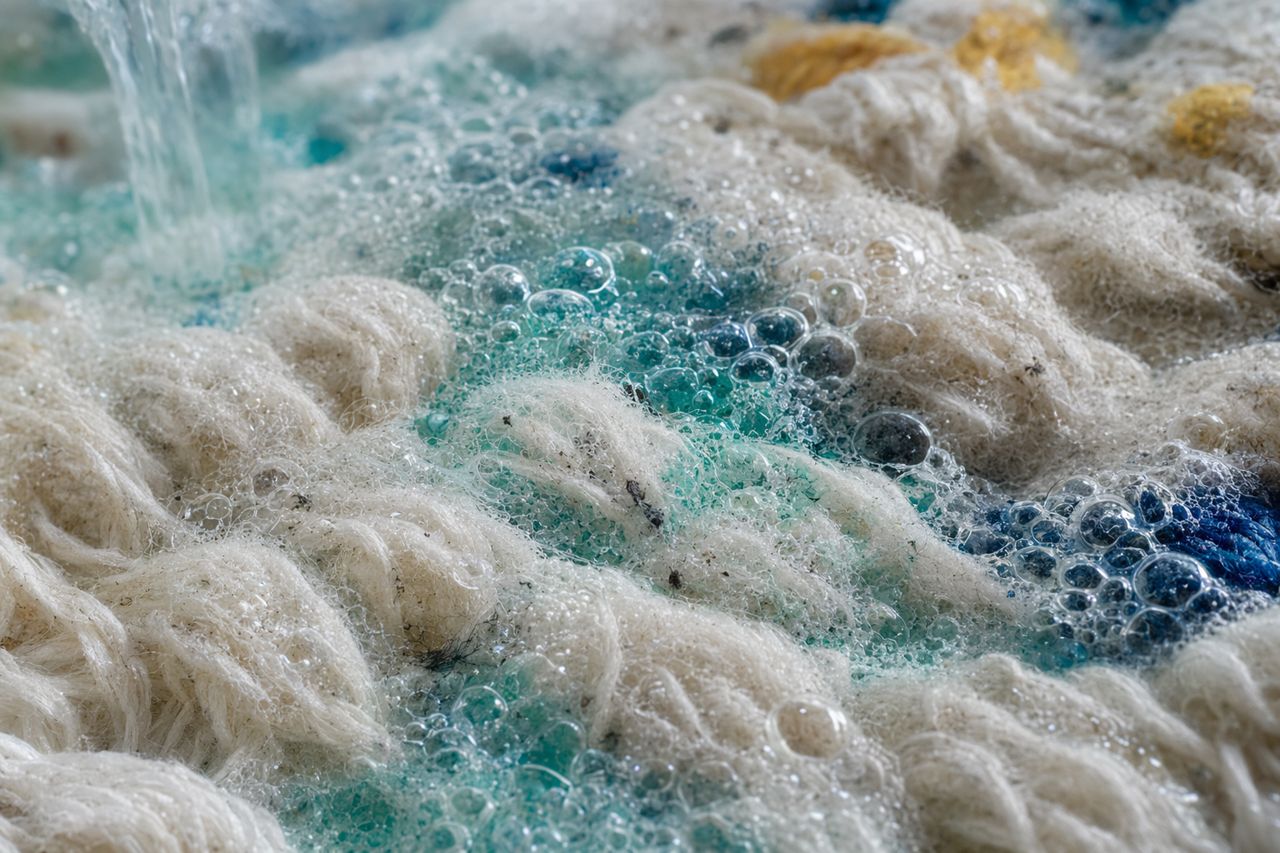
Cotton fibers can form microfibrils at the surface. Over cycles, these raised fibers trap soil, scatter light, and increase linting. Enzyme-enabled surface management can be one tool in the formulation system, particularly where cotton appearance is a brand priority.
Enzymes are not a generic shortcut to textile life claims. They must be selected for the target substrate, wash conditions, and full detergent matrix. Used correctly, they can support a more refined formulation strategy.
Cellulase is commonly used where cotton and cotton-rich textiles require surface appearance support. In an appropriate detergent system, it can help manage raised microfibers that contribute to fuzz, pilling perception, dullness, and lint release.
For commercial detergent manufacturers, the formulation question is not simply whether to add cellulase. It is whether the selected cellulase profile aligns with the product format, wash pH, water profile, surfactant package, preservative system, and target textile mix.
Soil-specific enzymes can improve removal of proteinaceous, fatty, and starch-based soils. When a detergent system cleans more efficiently, formulators may be able to reduce reliance on more aggressive chemistry in selected applications. That can support a textile-care narrative, provided claims are framed carefully and validated under realistic wash conditions.
In some institutional environments, gums, thickeners, sauces, and personal-care residues can create persistent soil loads. Specialty enzymes may strengthen removal of these soils and reduce the need for repeated rewashing, which itself can contribute to textile wear over time.
A textile life extension message must be built on controlled formulation logic. Buyers will ask whether the concept survives real production, storage, and field use.
Important variables include:
Foamforge works with manufacturers at the ingredient-selection stage so enzyme choice supports the commercial format rather than forcing late-stage reformulation.
Textile life extension is a powerful selling point, but it should be handled with precision. Overstated claims create risk for detergent brands, especially in institutional and industrial channels where buyers test products under their own conditions.
A responsible positioning framework may include:
Appropriate language often focuses on fabric appearance, lint management, surface smoothness, brightness retention, and reduced visible wear under defined laundering conditions. Avoid implying that detergent alone can prevent all textile degradation.
Commercial buyers care about replacement cost and customer satisfaction. Position textile care as part of a broader value proposition: cleaning efficiency, fabric presentation, operational consistency, and fewer avoidable wash-related defects.
Cotton towels, cotton-rich workwear, polyester-cotton uniforms, healthcare linens, and hospitality sheets do not respond identically. Claim language should be aligned with the textile families used in internal and customer testing.
Stronger claims require stronger validation. Rather than promising extended garment life universally, manufacturers can communicate that the detergent is formulated to help maintain fabric appearance over repeated wash cycles.
Textile-care positioning can support several product categories:
The most credible products connect the claim to a defined formulation architecture, not a decorative enzyme listing.
When sourcing bulk enzymes for detergent manufacturing, procurement and formulation teams need more than a sample. They need supply confidence, technical alignment, and practical scale-up support.
Key manufacturing questions include:
Foamforge helps manufacturers evaluate enzyme options in the context of finished-product design, not as isolated additives.
Depending on test design and product format, detergent brands may explore claim territories such as:
Final wording should be reviewed against test data, target market regulations, and customer usage conditions.
The strongest textile life extension positioning starts before fragrance selection, packaging copy, or sales training. It begins with the detergent architecture: enzyme blend, surfactant system, alkalinity profile, builder strategy, compatibility controls, and production realities.
For industrial cleaning product manufacturers, that means treating fabric care as a performance design target, not a late marketing layer.
If your team is developing a commercial laundry detergent, upgrading an institutional concentrate, or adding an enzyme-based textile-care line extension, Foamforge can help evaluate ingredient options and scale-up fit.
Request a quote through the on-site form to discuss enzyme sourcing, compatibility priorities, and bulk supply requirements for your detergent platform.
Tell us your application and volume — we reply with pricing and lead time.